
Mo Mengchu 莫孟初
1920-2012
Mo Mengchu (1920–2012) was a distinguished Chinese painter whose lifelong dedication to traditional and Western painting techniques earned him widespread acclaim, numerous prestigious accolades, and elite institutional recognition.
Artistic Journey & Style
Born into a scholarly family in Yingshan, Sichuan, Mo developed a passion for literature and arts at an early age. Between 1940 and 1943, during the War of Resistance Against Japan, he demonstrated his commitment to his craft by walking to Chengdu to study at the Sichuan Art School. There, he established a foundational mastery of traditional Chinese painting and Western techniques under the guidance of early Chinese masters Wang Chaowen and Zhao Wanbi.Throughout his career, Mo engaged in peer dialogue and artistic exchange with renowned painter Sun Qifeng and formed a close network with notable Sichuan painters like Wu Yifeng, Zhao Yunyü, Su Baozhen, and Zhu Peijun. Characterized by free, fluid, and concise brushwork, his style brought birds, insects, flowers, and landscapes to life with vibrant, natural vitality. Despite his high standing, he lived a modest, reclusive life, prioritizing the mentorship of younger generations across China and internationally over commercial interests.
Major Career Milestones & Timeline
- 1960: His piece “Nursery During the Busy Farming Season” was selected as a prestigious national gift presented by President Liu Shaoqi to heads of state during an official tour of ten Eastern European countries.
- 1980–1995: Participated extensively in provincial and national exhibitions, winning multiple awards.
- 1996: Earned the “Cross-Century Ink Art Talent” distinction from China National Radio. He won the Gold Prize at the “Shan and Water” Painting Competition in Shenzhen and was jointly named a “World Renowned Calligraphy and Painting Artist” by sixteen international art organizations.
- 1997: Won the Gold Prize at the Second Prince Lin Cross-Strait Calligraphy and Painting Exhibition and was honored as a “Cross-Century Talent”.
- 1998: Awarded the Gold Prize at the China Calligraphers’ Fine Art Exhibition and named one of the “Top 100 Outstanding Contemporary Artists”.
- 1999: Three of his works—“Fisherman’s Song,” “Spring Warmth,” and “Timid Melon Theft”—were selected for the Second National Flower-and-Bird Painting Exhibition. He was appointed Honorary President of both the Huaihai and Caozhou Youth Painting Academies, served as Art Consultant to the Xu Beihong Art Research Center, and received the “World Gold Medal Artist” certificate.
- 1997 & 2000: Expanded his international footprint by holding two highly successful solo exhibitions in Singapore.
- 2002: The Sichuan Artists Association hosted the “Mo Mengchu Retrospective Exhibition” at the provincial art exhibition hall, receiving high critical acclaim and resulting in museum acquisitions.
Would you like me to draft an introductory speech or promotional copy for his upcoming exhibition in Singapore based on these biographical details?
一、 学术前言:“世纪丹青”花鸟画的传统与现代性
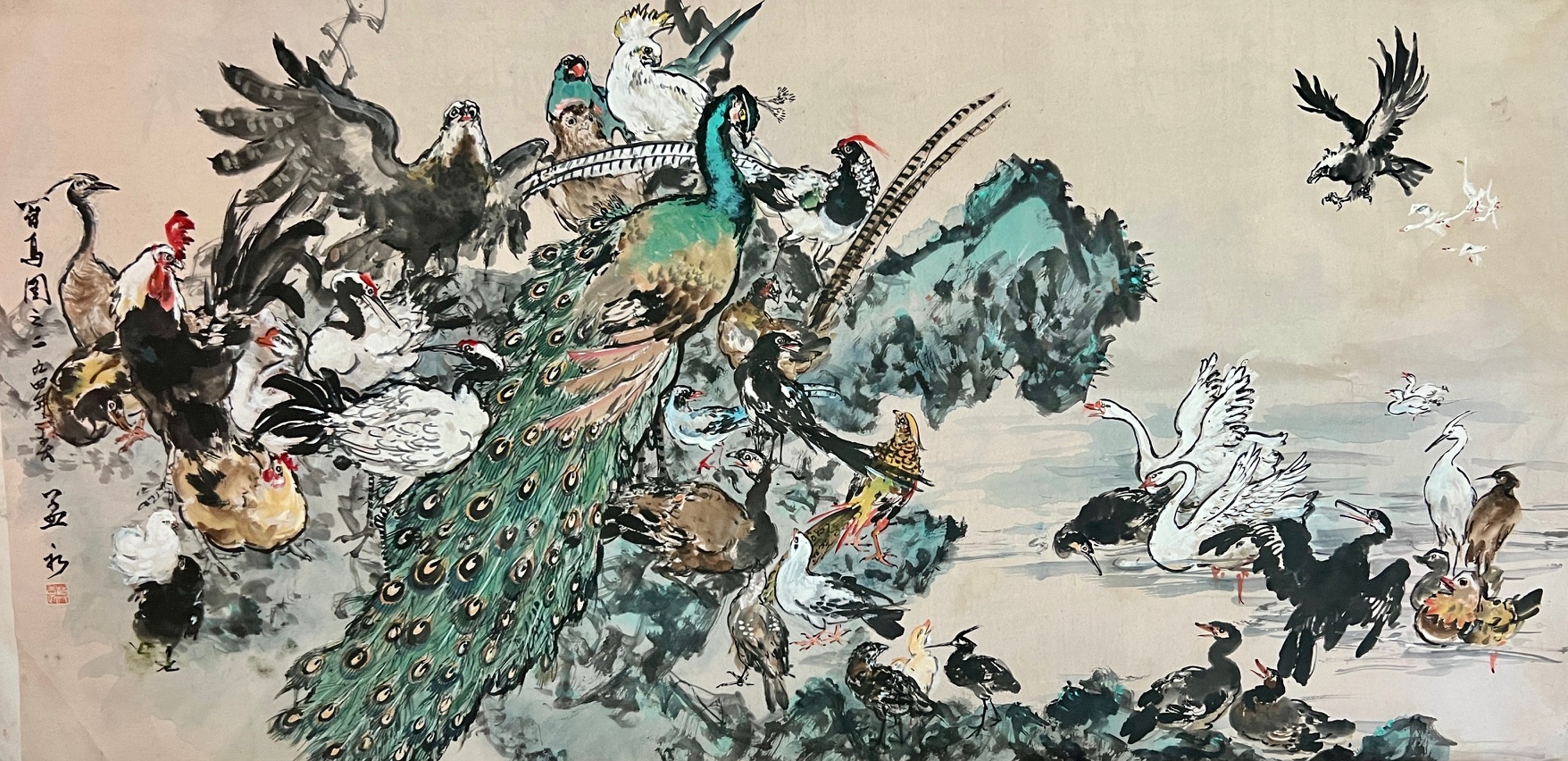
在中国传统绘画中,花鸟画是一个高度成熟的独立门类,其核心在于“借物抒情、托物言志”。自宋元以来,工笔与写意两大传统并行,而写意花鸟最能体现文人画的精神——强调笔墨生动、气韵生动,在具象之外营造诗意。莫孟初先生的花鸟画创作,正是对这一伟大艺术传统的杰出承续与发展。在其百余年的艺术生涯中,花鸟题材始终居于其创作的核心地位。他依托深厚的传统笔墨功底,继承了中国大写意花鸟的语言,同时融入了个人的生活阅历与时代审美,使作品既具备传统的厚重,又彰显了时代的生命力。本次展览精心挑选的六十幅花鸟精品,集中呈现了他在该领域数十年的探索成果。
1. 文化意象与符号认同
莫孟初先生钟爱描绘在中国传统文化中具有深厚象征意义的题材,如梅花、桃花、群鸡、飞鸽及春鸟。梅花之傲骨凌霜、桃花之春意盎然、家鸡之勤勉吉祥、飞鸽之和平美好,这些自然物象经由他的提炼,构建出一个充满温情与生命力的艺术世界。这不仅是对自然美景的描摹,更是对中华民族文化精神的视觉外化。
2. 章法布局与空间律动
在构图上,莫老将传统“经营位置”的法则运用得炉火纯青。其画面主次分明、虚实相生、疏密有致,在整体的沉稳中寻求灵动的变化。无论是群鸡聚集的烟火气、飞鸽翱翔的动态瞬间,还是斜梅双鸟的诗意对望,皆能精准掌控空间的节奏与气势,既符合传统章法,又保留了自然的活泼生机。
3. 笔墨意趣与色彩融合
- 骨法用笔:他的线条刚健有力、干练潇洒,在法度之中寻求顿挫变化。羽毛多以泼墨与积墨结合,兼具质感与形体;枝干则以中锋写出,苍劲挺拔,力透纸背。墨色的干湿浓淡在宣纸上交织,形成了独特的视觉音律。
- 以色助墨:在色彩处理上,莫老追求典雅与淡润。虽以水墨为主基调,但他善用淡粉、朱砂、赭石等色点染花瓣与鸟类局部,使画面在水墨的纯净中透出春天的明丽,达到了“色墨协调、淡雅淡施”的高超境界。
二、 艺术家生平及创作纪年
莫孟初先生(1920–2012)出生于四川营山的书香门第,毕业于四川艺专,毕生投身于中国画的教学与创作。他生前历任中国美术家协会会员、四川美术家协会会员、国家高级工艺美术师等职。在青年时代,他求学于四川艺专,得益于王朝闻、赵完壁等美术大师的亲传,打下了坚实的国画传统与西洋画造型基础。此后,他与孙其峰等北方大家交换作品、切磋画艺,并与吴一峰、赵蕴玉、苏葆桢、朱佩君等蜀中名家结为师友,共同探讨笔墨创新,从而跻身国画界前辈画师之列。莫老一生虚怀若谷,不慕名利,在市场经济的浪潮中甘于寂寞,隐居授业,其弟子不仅遍布祖国各地,更远及大西洋彼岸。
艺术生涯核心纪年表
- 1920年:出生于四川省营山县书香小康之家,自幼接受良好的文化熏陶。
- 1940–1943年:抗日战争期间,历尽艰辛步行至成都,就读于四川省立艺术专科学校(四川艺专)。
- 1960年:创作的现实主义题材作品《农忙托儿站》被选为国家礼品,由国家主席刘少奇出访东欧十国时赠予外国元首。
- 1966–1976年:在动荡的文化大革命时期坚持对艺术的执着。
- 1980–1995年:重返画坛,频繁参加各级国内外美术大展并屡获殊荣。
- 1996年:获评中央人民广播电台“跨世纪翰墨艺术人才”。同年,由中国国际美协等十六家国际艺术团体联合审定颁发“世界书画艺术名人”证书,并荣获深圳特区“山和水”书画大赛金奖。
- 1997年:9月凭作品荣获第二届“王子杯”海峡两岸书画大展金奖。同年,首次应邀在新加坡举办个人画展,获得圆满成功。
- 1998年:荣获中国书法家艺术精品展金奖,并被评为“当代百杰优秀艺术家”。
- 1999年:作品《渔歌》、《春暖》、《偷瓜怯》同时入选全国第二届花鸟画展。同年受聘为南京徐悲鸿艺术研究中心顾问,并获世界书画协会颁发“世界金奖艺术家”证书。
- 2000年:再度在新加坡举办个人画展,诸多杰作被海外藏家与艺术机构永久珍藏。
- 2002年:四川省美术家协会于四川省美术展览馆为其举办大型“莫孟初先生回顾展”,社会反响强烈,多数精品被省博物馆及美术馆典藏。
三、 传承与后记:笔墨长流的世纪追思
此次在新加坡举办的百年诞辰回顾展,不仅是一次系统性学术成就的梳理,更是一次带有家族温情的精神致敬。正如莫老之女莫尼女士在后记中所述,艺术的承传绝非形式的简单复制,而是人格修养与笔墨精神的血脉相连。莫老一生强调“正心成艺”,将绘画视为人格的修炼。莫尼女士移居新加坡多年,在秉承父亲“骨法用笔”与艺术风骨的同时,不断探索属于自己的艺术语言,使流淌在宣纸上的丹青精神,在新的跨文化语境中焕发出全新的生命力。百年光阴流转,老艺术家虽然已经离去,但他所守护的笔墨与风骨,依然在时间的长河中长久回响。
Artists You May Like
5 work(s)
Previous
Next



媒介:水墨-尺寸:98cmX53cm-scaled.jpg)

媒介:水墨-尺寸:102cmX58cm-scaled.jpg)


-媒介:水墨-尺寸:96cmX54cm-scaled.jpg)